Beauty Unions, Trade Associations, and Female Leadership
- Feb 24
- 4 min read
Updated: Mar 30
Less than a century after the Civil War—and squarely in the heart of the Jim Crow era—Black women were building businesses, training workers, and shaping communities in one of the few industries open to them: beauty culture. During this time beauty unions, trade associations, and female leadership helped shape the beauty labor industry into what it is today. However, Black women fought to overcome racial segregation, and white-only unions, schools, and licensing boards that excluded African Americans.
In this hostile climate, the National Beauty Culturists’ League (NBCL), founded in 1919, emerged not only as a professional association but also as a movement for racial uplift, political representation, and women’s leadership. It stood as a rebuttal to the prevailing assumption that beauty work was frivolous. While the NBCL was not a formal labor union in the AFL–CIO sense, it functioned as a trade organization that provided education, certification, advocacy, and political mobilization. Like a union, it fought for representation on state boards, higher professional standards, and the political and economic interests of its members.
Beauty culture gave Black women something Jim Crow tried to deny: economic independence. Tiffany Gill describes beauty shops as important community spaces where African American women could gather free from white surveillance, share information, and organize collective action. The NBCL recognized this power early on, reframing beauty work as a profession tied to dignity, service, and self-determination—values that directly confronted the racist caricatures used to justify our exclusion.
The League’s annual conventions were political classrooms disguised as professional conferences. Alongside styling competitions and technical workshops, members attended sessions on public health, business management, and civic engagement. Leaders like Sarah Spencer Washington reminded Black cosmetologists that their professional success was inseparable from the fight to “beautify the race.” Political speakers and civil rights organizers were as much a part of the program as hair educators.
Representation was a constant fight. As Paul Moreno explains, the white male AFL unions, like the Barbers, Beauticians, and Allied Industries Union, “used local ordinances controlling licensing and apprenticeship to keep blacks out of their trades.” However, this larger, white, and male-dominated union did not succeed in influencing Alabama’s cosmetology licensing laws, as Alabama Black cosmetologists were organized in smaller, more localized beauty unions and groups. And these small groups had support. In Alabama, NBCL members called for “the admission of Negro beauticians on state boards of cosmetology as members, supervisors and inspectors.” Supporting local Black unions, they challenged licensing systems that had long been used to exclude African Americans, petitioning for Black inspectors and demanding diverse representation in the regulatory bodies overseeing their work. This made it clear that the structures regulating beauty work could not remain all-white if they claimed to serve the entire industry.
This work embodied the philosophy of racial uplift. NBCL leaders believed that skilled, politically engaged beauty professionals could serve as role models and catalysts for community progress. They funded scholarships, built training programs, and fought for professional validation, transforming cosmetology into a respected vocation—one that demanded both skill and leadership.
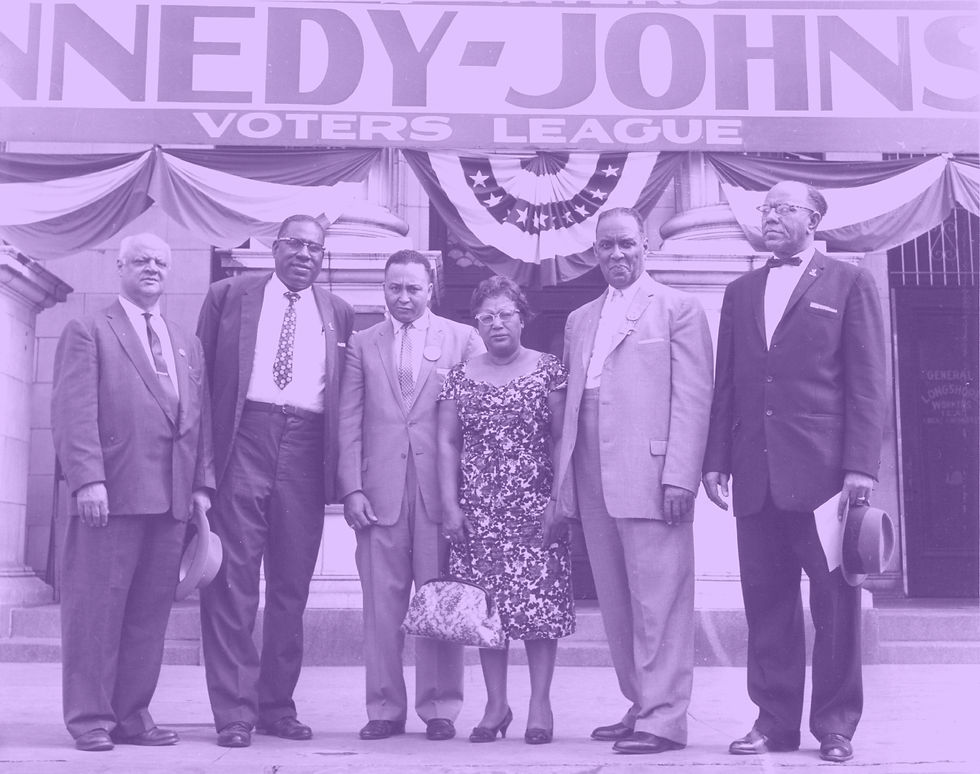
In 1955, Katie Ethel Whickam of the Dryades Street School of Beauty Culture and Barbering helped form the Metropolitan Women’s Voters League (MWVL). Wickham was also the president of the National Beauty Culturists’ League for 27 years. As the League’s president, she established relationships with prominent leaders, including Martin Luther King Jr. and national Democratic Party politicians such as John F. Kennedy.
According to Neidenbach, the National Democratic Committee supported the MWVL in its effort to register 100,000 Black voters in the state of Louisiana. Whickam exemplified the type of female leadership that the NBCL cultivated. Her political activism supported a community of beauty professionals, as well as the salon’s patrons. Under her, the League’s activism extended beyond the salon door. Salons functioned as civic hubs or “citizen schools,” where clients could register to vote, discuss candidates, and learn about civil rights campaigns in spaces safe from white interference. Additionally, the NBCL also fought to protect consumers, challenging companies that pushed unsafe, substandard products into Black communities.
The NBCL’s work took place in an America still shaped by the racial hierarchy of slavery. Many of their members were daughters or granddaughters of enslaved people. They understood that beauty work, in their hands, could be more than a living—it could be a form of resistance, a claim to space, and a means of building power.
The National Beauty Culturists’ League and its leaders left a legacy that serves as a reminder that beauty work has always been a form of political expression. They fought for representation in decision-making bodies, raised professional standards without locking out working-class women, and linked aesthetics to liberation.
In today’s current political climate, as fascism grows in the United States, cosmetologists would do well to look to history and remember that the salon was a place of social, political, and communal innovation. Perhaps it is high time to revive this type of political activism model in our salons and be the change we want to see. As Dr. Katie Whickham once said, “you can cure all evils with the almighty ballot.”
Bibliography:
Corley, Tanner. “Regulating Beauty: The Licensing of Barbers and Beauticians in Alabama and the Nation.” Enterprise & Society, 2025.
Gill, Tiffany M. Beauty Shop Politics: African American Women’s Activism in the Beauty Industry. Urbana: University of Illinois Press, 2010.
“National Beauty Culturists’ League,” August 11, 2025. https://www.nbcl.info/about-us.html.
Barney, Tammy C. “Katie Ethel Whickam helped harness the power of Black New Orleans beauticians,” August 9, 2024, accessed August 11, 2025. https://veritenews.org/2024/08/09/bitd-katie-ethel-whickam-black-beauticians-voting/
Neidenbach, Libby. “Beauty and the Ballot: New Orleans Civil Rights Activist Kaite Whickam,” September 14, 2023, accessed on August 11, 2025, https://hnoc.org/publishing/first-draft/beauty-and-ballot-new-orleans-civil-rights-activist-katie-whickam


Comments